Best AI-Powered Scheduling Software for Construction Superintendents and Teams
Table of Contents:

For decades, construction schedules were built by hand — on whiteboards, spreadsheets, or bulky project files. But as projects have grown more complex, so has the need for faster, smarter planning. Today’s superintendents and project managers are turning to AI-powered scheduling software to coordinate crews, track progress, and predict potential delays before they happen.
Unlike traditional scheduling tools, AI-driven platforms don’t just record timelines — they learn from them. These systems analyze past project performance, real-time field data, and environmental conditions to forecast risks and recommend adjustments automatically. The result is a more agile schedule that evolves alongside the project, reducing downtime and improving overall productivity.
For construction teams juggling multiple trades and shifting priorities, AI scheduling software has become indispensable. It helps keep crews aligned, materials arriving on time, and deadlines realistic — all while minimizing manual oversight. In this article, we’ll explore the essential features and best practices behind AI-powered scheduling software, showing how it helps contractors deliver projects faster, safer, and with fewer surprises.
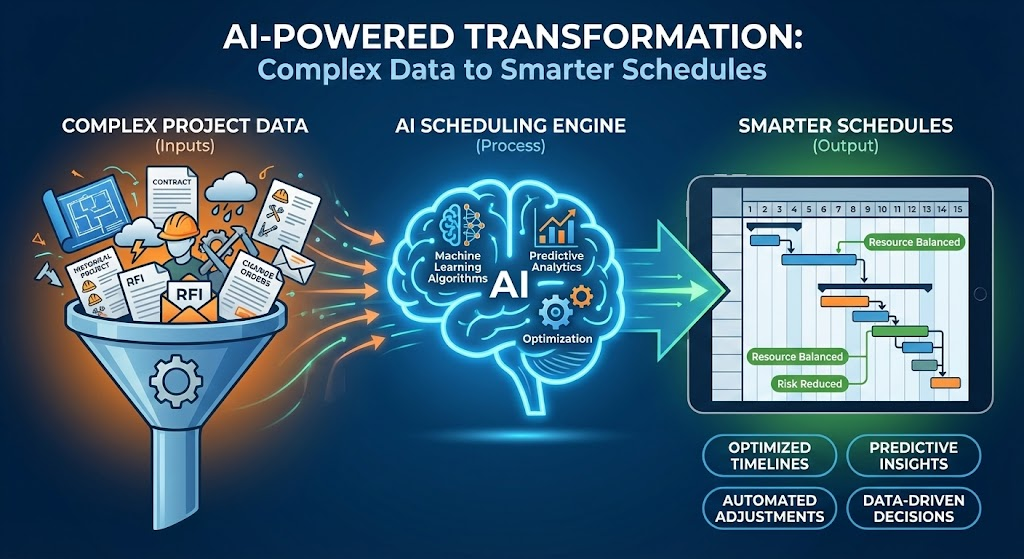
Turning Complex Project Data Into Smarter Schedules
Every construction site generates a constant flow of information — from crew hours and equipment usage to deliveries and inspections. AI scheduling software harnesses this data to automate updates, identify conflicts, and adjust plans in real time. Instead of manually revising Gantt charts or spreadsheets, superintendents can view automatically updated schedules that reflect what’s actually happening in the field.
This automation eliminates hours of manual input and prevents cascading delays caused by outdated information. AI also analyzes patterns across projects to forecast where future bottlenecks might occur. By learning from every schedule revision, it becomes more accurate over time — helping teams plan smarter and execute with precision.
Top Benefits
- Updates project schedules automatically based on live field data
- Identifies conflicts and dependencies before they cause delays
- Reduces administrative time spent revising schedules manually
Best Practices
- Connect AI scheduling tools to daily reports and delivery logs for full context
- Review AI-generated updates weekly to confirm accuracy
- Train field leads to input progress data consistently for better predictions
Q&A Mini Section
Q: How does AI learn from project data?
A: It analyzes trends and outcomes across tasks to refine predictions with each completed project.
Q: Can AI-generated schedules replace human planners?
A: No — they assist planners by handling repetitive updates and highlighting risks earlier.
Q: What’s the biggest advantage for superintendents?
A: Real-time visibility and faster reactions to site changes.
AI scheduling tools take the guesswork out of project planning, empowering teams to focus on execution rather than endless rescheduling.
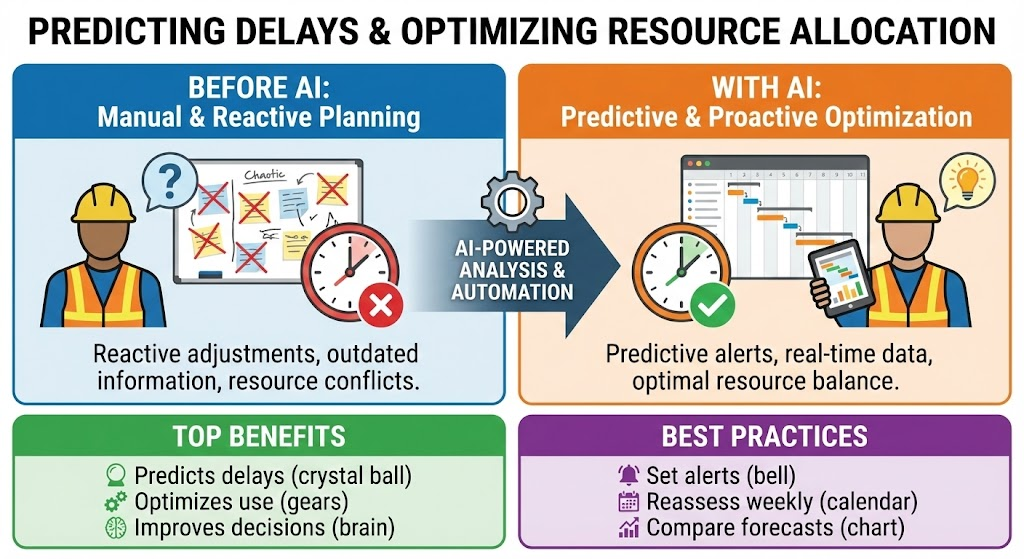
Predicting Delays and Optimizing Resource Allocation
AI-powered scheduling systems can detect potential delays long before they appear on the calendar. By analyzing weather forecasts, delivery schedules, crew productivity, and trade dependencies, the software generates predictive alerts that help superintendents stay ahead of disruptions.
For instance, if material shipments are consistently late or labor availability drops, the system recalculates timelines automatically and recommends reassignments. This level of insight allows managers to balance resources more efficiently — shifting manpower or equipment to critical areas before delays escalate. Over time, predictive models learn your company’s workflows and become more precise at identifying high-risk activities.
Top Benefits
- Predicts and mitigates delays before they affect milestones
- Optimizes labor and equipment use based on live progress data
- Improves decision-making through predictive analytics and simulations
Best Practices
- Set up automated alerts for weather, delivery, or dependency risks
- Reassess manpower allocations weekly using AI recommendations
- Compare AI forecasts against actual outcomes to calibrate accuracy
Q&A Mini Section
Q: How early can AI detect scheduling risks?
A: Often days or even weeks ahead, depending on data inputs and project complexity.
Q: Does it account for outside variables like weather?
A: Yes — most AI scheduling systems integrate with weather APIs for risk forecasting.
Q: How does it improve resource management?
A: By aligning labor and equipment with real-time progress and forecasted needs.
Predictive intelligence transforms scheduling from static planning to dynamic foresight — giving superintendents the data to prevent problems, not just react to them.
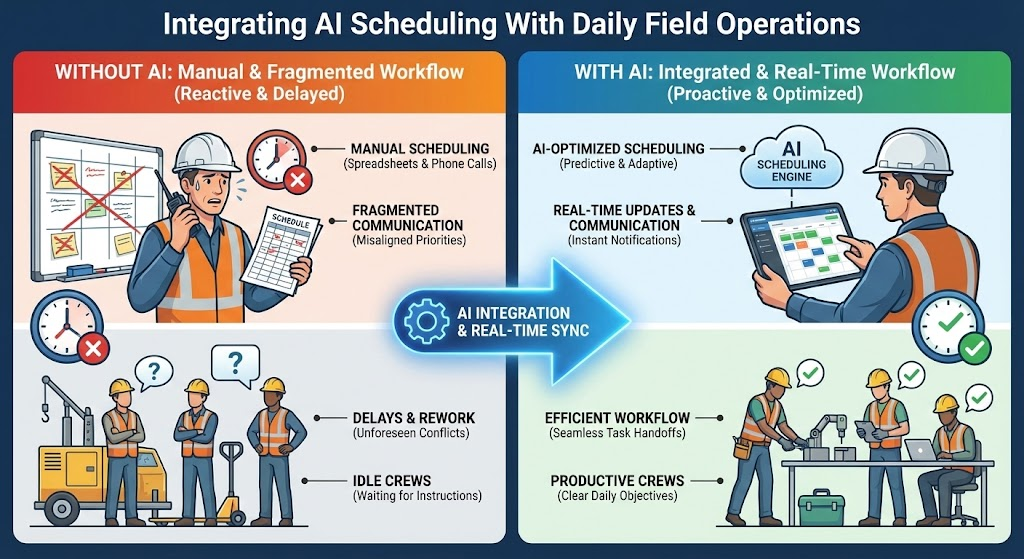
Integrating AI Scheduling With Daily Field Operations
The most effective AI scheduling software isn’t just a planning tool — it’s a live extension of daily jobsite management. When integrated with field reporting, delivery tracking, and safety systems, it ensures that every part of the project is synchronized.
Superintendents can see how schedule updates directly impact crew assignments, material usage, and inspection timelines. Field teams can log progress from mobile devices, automatically feeding real-time data back into the system. The AI then adjusts task sequences, delivery expectations, and manpower distribution to maintain efficiency. This connected ecosystem ensures that decisions made in the office instantly reflect in the field — and vice versa.
Top Benefits
- Keeps schedules aligned with field data and daily progress
- Reduces miscommunication between project managers and crews
- Creates a seamless feedback loop between planning and execution
Best Practices
- Integrate AI scheduling software with existing site management tools like StruxHub
- Encourage foremen to log updates immediately after task completion
- Review updated task sequences daily to confirm field alignment
Q&A Mini Section
Q: Can AI scheduling tools integrate with StruxHub?
A: Yes — StruxHub connects with scheduling systems to share field data and automate updates.
Q: How does integration improve accuracy?
A: It ensures schedules always reflect real conditions, not outdated assumptions.
Q: Do crews need to learn new software?
A: Minimal training is needed — most integrations work through mobile apps they already use.
AI integration turns scheduling into a living process — one that adapts as fast as the jobsite changes, keeping superintendents fully in control.

StruxHub
Experience the power of StruxHub today and witness firsthand how it can revolutionize your construction operations.
Advanced Forecasting and Scenario Planning for Complex Projects
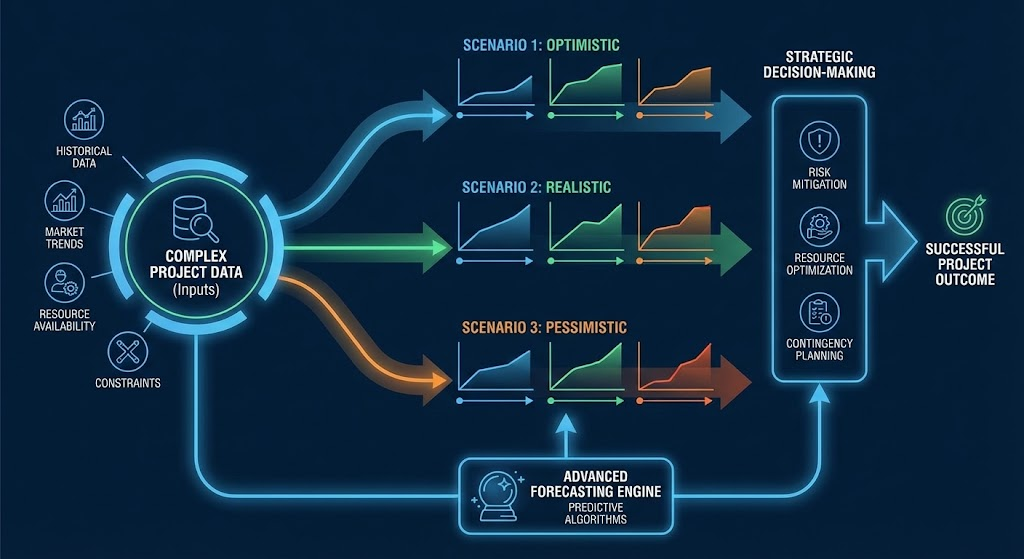
AI-powered scheduling software gives superintendents the ability to think several steps ahead. Through advanced forecasting and scenario planning, these tools allow users to model “what-if” situations — such as material shortages, weather delays, or overlapping trade work — before they happen. Superintendents can test the impact of different changes, then use AI recommendations to select the most efficient path forward.
For large, multi-phase projects, this level of forecasting is invaluable. It ensures that decisions about crew sequencing or resource allocation are based on data rather than gut instinct. The AI continuously compares live field data against baseline plans to detect when a project is trending off schedule, then suggests corrective actions automatically. These adjustments might include shifting manpower, rescheduling deliveries, or even altering work sequences to recover lost time.
Top Benefits
- Simulates potential risks and recommends best-case scheduling solutions
- Helps recover lost time through proactive reallocation and sequencing
- Increases accuracy in forecasting completion dates and milestones
Best Practices
- Run weekly “what-if” analyses to anticipate delays or bottlenecks
- Use forecasting dashboards to visualize schedule sensitivity and risk levels
- Compare AI-generated recovery plans with historical outcomes for validation
Q&A Mini Section
Q: How detailed can AI forecasting get?
A: It can simulate scenarios by trade, phase, or individual activity, providing multiple recovery options.
Q: Can it adjust schedules automatically after delays?
A: Yes — most systems update timelines and resource allocations automatically.
Q: How does scenario planning help large projects?
A: It enables data-backed decisions that prevent small issues from snowballing into major delays.
Forecasting tools give superintendents a powerful edge — transforming scheduling from a reactive routine into a strategic, predictive discipline.
Real-Time Collaboration Tools That Keep Teams in Sync
Scheduling efficiency depends on clear communication. AI-powered scheduling software centralizes this process by combining live scheduling data with communication tools designed for jobsite coordination. Instead of sifting through emails or calls, everyone works from the same shared timeline, with automated notifications for task changes, delays, or dependencies.
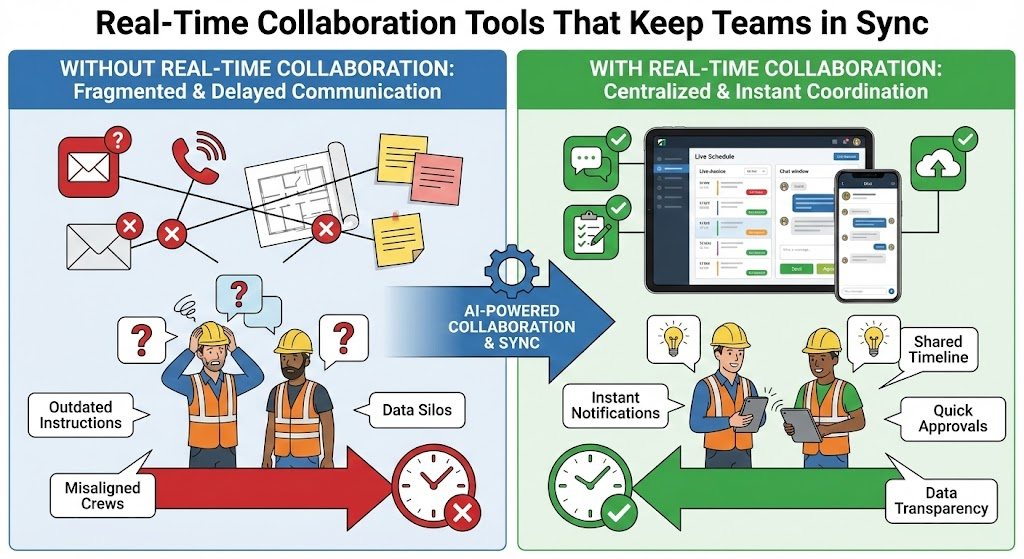
Superintendents can tag crew leads, reassign responsibilities, and confirm updates instantly. These features ensure that every trade understands what’s expected — reducing downtime and miscommunication. Integrated chat, task updates, and digital approval workflows make coordination frictionless, whether teams are in the office, the field, or remote.
Top Benefits
- Keeps all stakeholders aligned to one live, continuously updated schedule
- Eliminates confusion about changing timelines or task ownership
- Improves audit trails with timestamped communication records
Best Practices
- Encourage crews to use in-platform comments for clarifications or updates
- Host coordination meetings using live schedule views instead of static reports
- Set notifications for critical dependencies or milestone changes
Q&A Mini Section
Q: How does AI scheduling improve communication compared to traditional methods?
A: It ensures all updates happen in real time, preventing outdated instructions.
Q: Can owners or clients access live schedules?
A: Yes — with read-only permissions for transparency and trust.
Q: Are communication records archived for compliance?
A: All exchanges are timestamped and stored, creating a full audit history.
When communication happens inside the schedule itself, coordination becomes seamless — helping superintendents manage crews efficiently and stay on track every day.

StruxHub: Revolutionizing Project Management in Large Commercial Construction
Data Analytics That Drive Continuous Improvement
AI scheduling software doesn’t just optimize today’s projects — it makes future ones better. Every activity logged, delay resolved, and milestone completed becomes a learning opportunity. Over time, analytics reveal patterns that improve forecasting accuracy and project performance.
These insights can identify which crews consistently hit targets, which suppliers cause delays, and which work sequences lead to the best outcomes. Superintendents can use this data to improve future planning, allocate resources more strategically, and even justify decisions to owners with quantifiable metrics. Continuous improvement isn’t just about hindsight — it’s about building smarter, more predictable operations with every project.
Top Benefits
- Tracks historical data to improve future scheduling accuracy
- Measures productivity, delay causes, and crew performance
- Strengthens decision-making through quantifiable progress metrics
Best Practices
- Review monthly analytics reports to identify recurring schedule risks
- Use trend data to fine-tune forecasting models
- Share success metrics with clients to demonstrate project reliability
Q&A Mini Section
Q: How does AI analytics differ from standard reporting?
A: It learns from outcomes to predict and prevent similar problems in future projects.
Q: Can it benchmark performance across different projects?
A: Yes — AI analytics aggregate company-wide data for pattern recognition.
Q: How does data improve superintendent performance?
A: It provides concrete insights into productivity and delay trends for targeted improvements.
AI analytics help teams evolve continuously, ensuring that each project runs smoother, faster, and smarter than the last.
StruxHub
Discover how StruxHub can revolutionize your construction management. Contact us today!
How StruxHub Helps Construction Teams Implement AI Scheduling
StruxHub simplifies the adoption of AI-powered scheduling by integrating predictive intelligence directly into its real-time project management workflows. Superintendents can create, adjust, and monitor schedules while the platform automatically syncs progress data from the field. When conditions change — such as delayed materials or updated task completions — StruxHub’s scheduling module recalculates dependencies instantly.
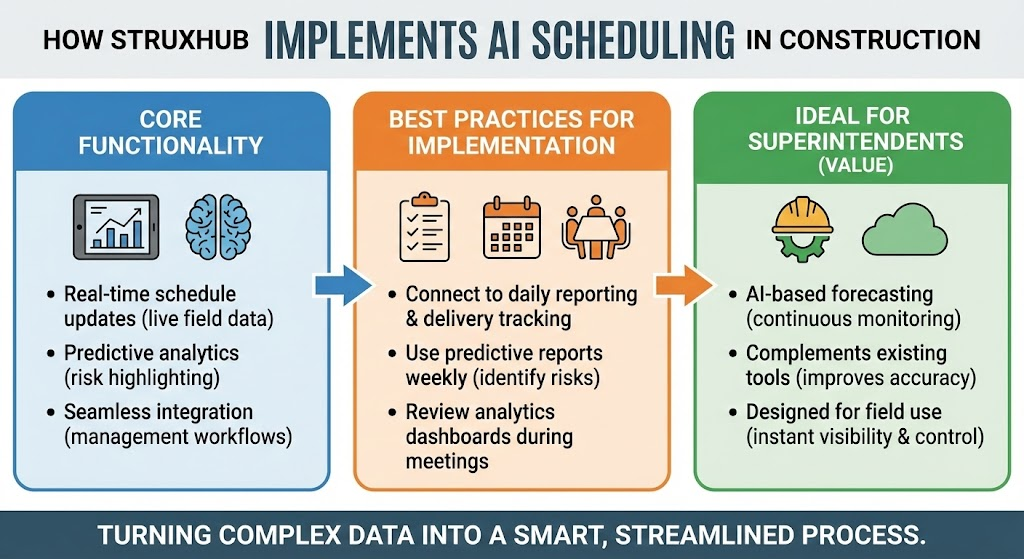
Beyond scheduling, StruxHub unites field communication, deliveries, and safety documentation into one cohesive system. Its AI-assisted analytics identify recurring bottlenecks and recommend solutions that prevent schedule drift. For superintendents, this means less time chasing updates and more time optimizing productivity. By connecting data from every corner of the project, StruxHub ensures your schedule is always current, accurate, and actionable.
Top Benefits
- Real-time schedule updates driven by live field data
- Predictive analytics that highlight risks before they cause delays
- Seamless integration with other construction management workflows
Best Practices
- Connect StruxHub scheduling with your daily reporting and delivery tracking
- Use predictive reports weekly to identify upcoming risks
- Review StruxHub analytics dashboards during coordination meetings
Q&A Mini Section
Q: Does StruxHub include AI-based forecasting?
A: Yes — it continuously monitors field data to predict and adjust scheduling risks automatically.
Q: Can StruxHub replace standalone scheduling tools?
A: It complements them, integrating real-time field updates to keep timelines accurate.
Q: What makes StruxHub ideal for superintendents?
A: It’s designed for field use, providing instant visibility, automation, and control.
StruxHub turns complex project scheduling into a smart, streamlined process — ensuring construction teams stay synchronized, efficient, and consistently on time.

FAQ: AI-Powered Scheduling Software for Construction Teams
1. What makes AI-powered scheduling software better than traditional construction scheduling tools?
Traditional scheduling tools are static—they rely on manual updates and don’t adapt quickly to changes in the field. AI-powered scheduling software, on the other hand, continuously analyzes live project data from crews, deliveries, weather, and equipment usage to keep the schedule current and predictive. It automatically identifies risks, recommends adjustments, and updates dependencies without requiring hours of manual input. This means superintendents can make proactive decisions instead of reacting to problems after they happen. The biggest advantage is that AI turns scheduling into a living system—dynamic, data-driven, and responsive to real-world conditions—helping teams maintain tighter control over timelines and resources while reducing costly rework.
2. How does AI scheduling software predict and prevent construction delays?
AI scheduling tools use algorithms trained on historical project data and real-time field updates to forecast risks before they become critical. For instance, the software can detect when a certain trade consistently falls behind or when equipment downtime may impact the next phase. It can also integrate weather data, delivery schedules, and crew productivity metrics to calculate likely disruptions. Once detected, the system notifies superintendents and recommends solutions—like resequencing tasks or reallocating resources—to recover lost time. By combining predictive analytics with automation, AI scheduling reduces uncertainty, enabling construction teams to act days or even weeks ahead of potential delays.
3. Can smaller construction companies benefit from AI-powered scheduling tools?
Yes, and often more than larger firms. Smaller contractors usually don’t have the staff to manage complex scheduling manually, so automation provides an immediate boost in efficiency. AI scheduling software simplifies daily coordination by updating tasks automatically, tracking dependencies, and alerting crews about changes. Because most platforms are cloud-based, they scale easily—contractors can start small and expand features as projects grow. AI tools also provide valuable analytics that smaller teams can use to refine workflows, improve bidding accuracy, and strengthen relationships with clients through consistent on-time delivery. In short, AI scheduling helps smaller firms compete at the same operational level as large general contractors.
4. How does AI-powered scheduling integrate with other construction management systems?
Integration is a core feature of most AI scheduling platforms. These systems connect directly with daily reporting tools, site operation management software, delivery tracking systems, and safety documentation platforms. By consolidating data across different workflows, they eliminate duplicate entries and keep every department aligned. For example, when a superintendent logs task progress or a delivery delay, the AI instantly recalculates the project timeline and updates dependent tasks across all systems. This interoperability ensures the office and field always share the same real-time schedule. Integration also strengthens analytics—combining safety, logistics, and performance data for deeper insight into project efficiency.
5. How does StruxHub use AI scheduling to support superintendents and project managers?
StruxHub’s AI-assisted scheduling module transforms traditional project planning into a proactive, real-time process. The platform automatically syncs field updates, adjusts dependencies, and flags risks that could impact key milestones. Superintendents can access all scheduling data from a mobile dashboard, track progress live, and communicate changes instantly to the field. The system learns from historical data, improving its predictive accuracy with each project. StruxHub also integrates seamlessly with reporting, delivery, and safety modules, ensuring every schedule reflects true field conditions. By combining automation, analytics, and AI forecasting, StruxHub helps construction teams maintain schedule integrity, reduce administrative load, and deliver projects on time, every time.